Context is scattered
State, history, alerts, and user intent live in different tools that do not share one view of the environment.
ORION product overview
ORION is being built to understand a request, gather the right context, choose an approved workflow, and check whether the systems involved reached the intended state.
The problem
A connected environment can include AI models, automation software, sensors, cameras, APIs, local services, and devices. Each tool sees only part of what is happening. ORION brings those pieces into one operating model.
State, history, alerts, and user intent live in different tools that do not share one view of the environment.
An AI model can interpret and plan, but actual control should pass through approved tools, permissions, and workflows.
Sending a command is not the same as completing the task. ORION is built around checking the result.
Current product interfaces
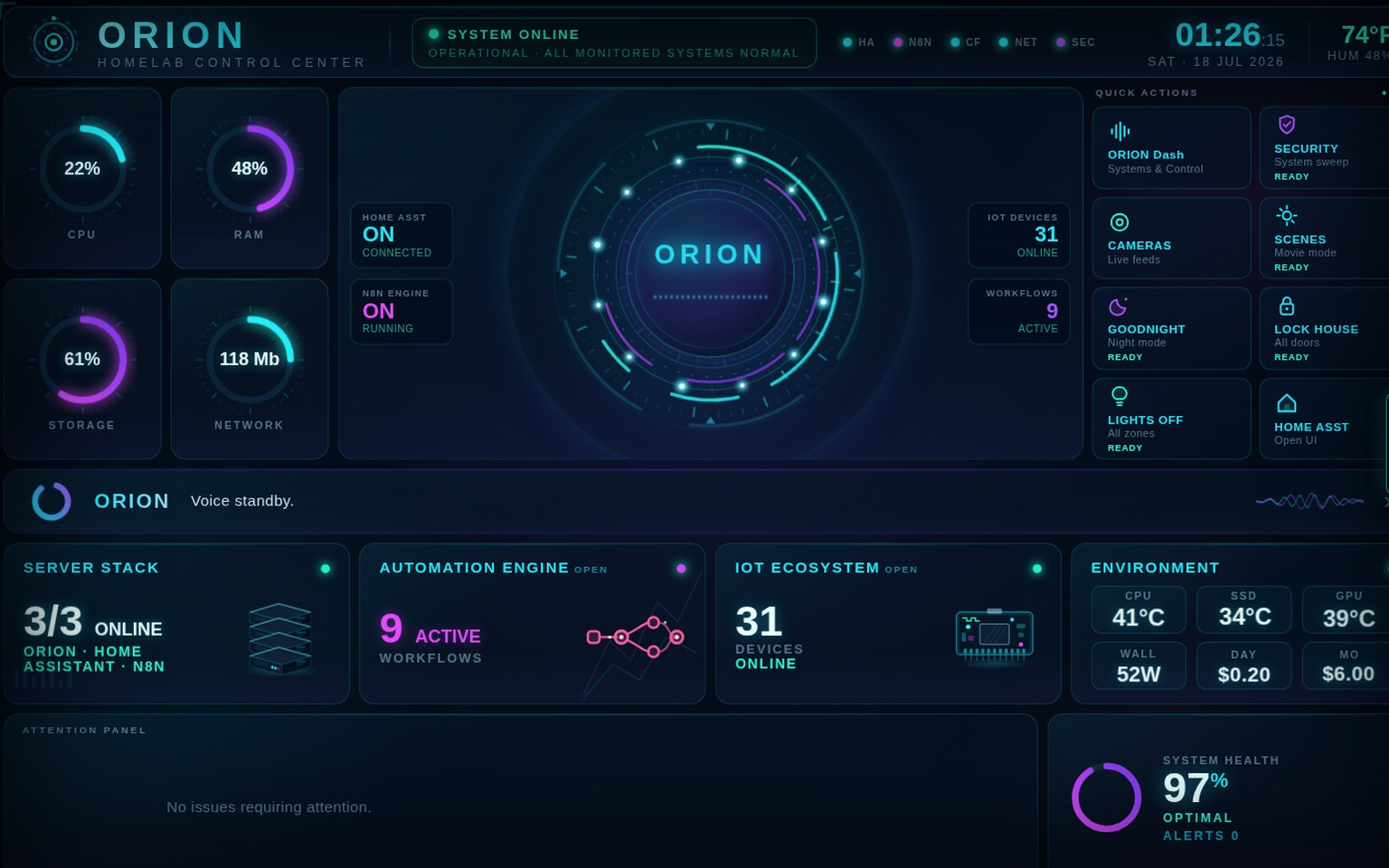
These screens use the authentic ORION frontend in the safe public demonstration. The private development deployment uses the same interface code with live services and system state, while the public version uses simulated data and no private access.
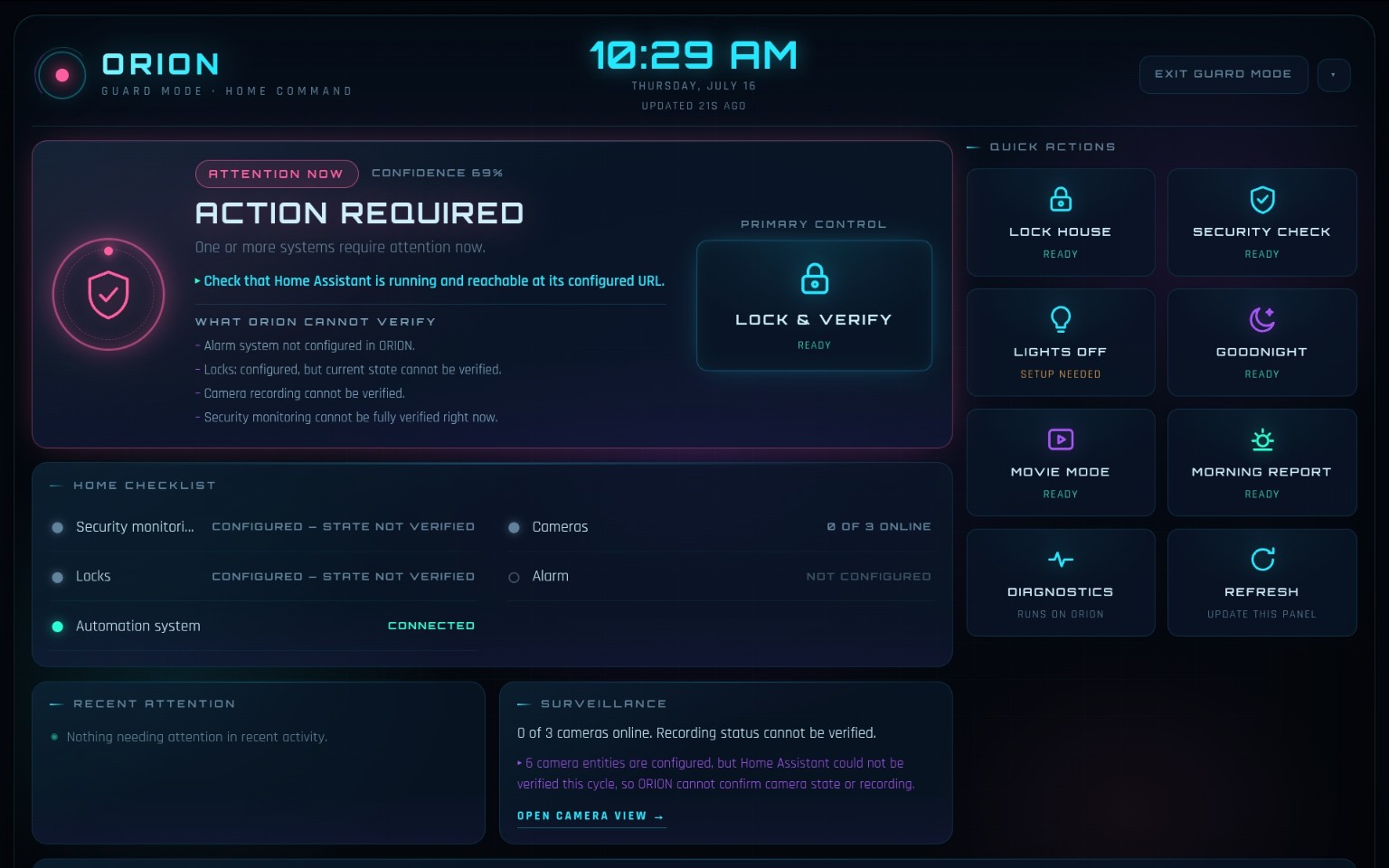
Shows what is ready, what needs attention, and what ORION cannot confirm from the available system state.
Brings service health, automation activity, connected devices, common actions, diagnostics, and alerts into one place.
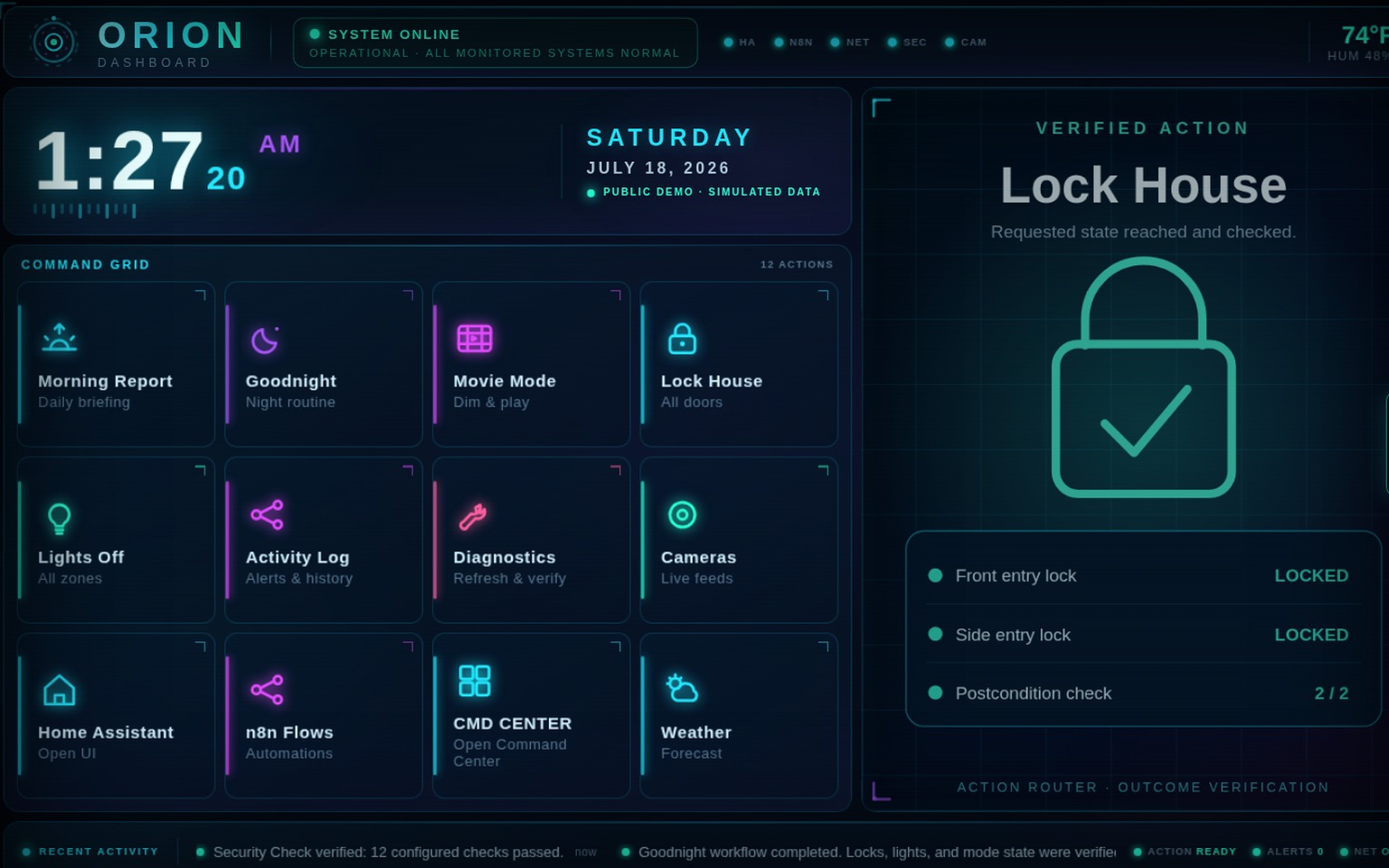
Provides a simple command grid for routines, cameras, diagnostics, event history, Home Assistant, n8n, and connected services.
Current implementation
The browser views do not contain private credentials or direct device-control logic. A local Node.js service reads system state, applies capability and policy rules, routes approved actions, records events, and returns structured verification results.
Safe public environment
The demo runs entirely in the browser, uses clearly labeled sample data, and simulates verification responses. No private camera, device, Home Assistant, n8n, or local-network access is exposed.
Why AI is core
AI is the decision layer. It interprets natural language, weighs context, helps plan the next step, chooses a structured tool, summarizes events, and explains uncertainty in a way a person can act on.
Turn a request into a clear goal that the system can act on.
Use live state, recent events, preferences, rules, and relevant memory.
Select a safe sequence of approved tools and workflows.
Describe what happened, what failed, and what could not be confirmed.
Request flow
The model helps decide what should happen. It does not receive unrestricted control. ORION sends approved actions through defined tools, then checks observable state before reporting the outcome.
Starting point
The first test environment has real devices, services, automations, cameras, routines, and changing state. It creates practical problems that a polished demo cannot reproduce, including outages, unavailable integrations, partial completion, and actions that need a second check.
Development status
ORION is working software in active development and is not yet generally commercially available. The public demonstration uses simulated data and does not connect to private production systems.
Product principles
Sensitive state and control logic can stay close to the environment.
The architecture can use local or cloud models as requirements change.
Offline services, uncertainty, and failed checks should be shown clearly.
Defined interfaces make it possible to add tools and services over time.
Product inquiries
For questions about the product, infrastructure, technical collaboration, or future partnerships, contact TylerInnovated at the business email below.